

The Blind Spot: You Think You Hear It, But You Don't
You have a problem, but you do not know that you have it. Can you solve a problem you are not aware of? No.
Here's the problem. When you listen to English, you think you hear 100% of what is said. It seems so , right? But the truth is, you don't. Your brain is for your native language, and it tends to ignore the sounds that exist in other languages but not in your own. You cannot what you do not clearly hear, can you? So, what you often do is stress (put the emphasis on) the wrong syllable in many words. You change the original music and rhythm of words, and that is why people often ask you to repeat.
It is frustrating, because you did all the hard work. Your grammar is correct. Your vocabulary is . When you are not understood, you often blame your words, your grammar or a single letter sound. The real is none of these. It is word stress, the extra emphasis you must put on one part (syllable) of a word when you say it out loud. Move the stress and the word changes: you sign a CONtract, but you conTRACT the work out. An INcrease is a thing; to inCREASE is something you do. Think of it as a hidden enemy: it stops you from understanding fast spoken English and prevents people from understanding you, even when everything else you said was right.
Learning word stress helps fix why native speakers often ask you to repeat yourself. The key is to understand how your native language sets the trap, why nobody taught you better before, and how to follow the five steps that will set you free.
Your First Language Sets the Trap
Many people believe that adults lose the ability to hear foreign sounds after childhood. Dr. Paul Iverson of University College London studies how adults can their brains to hear word stress, and his research shows that this belief is false. Adult ears still work fine. It is the brain that has been "" by the first language.
In early childhood, the brain learns to focus only on the sounds that matter in its native language. Later, in a second language, it tends to ignore the sounds that exist in other languages but not in the mother tongue. Your ears hear them, but your brain ignores them. That is what makes it harder for you to hear where the stress falls. You can't pronounce a sound your brain hasn't registered. Iverson's conclusion is that the adult brain stays enough to overcome "stress ." With short, structured, focused listening practice, adults can be retrained to hear word stress more clearly.
Other studies (Dupoux et al., 1997; Li, 2026) show that, for some speakers, the problem starts in the ear. In French, the stress usually falls on the last syllable. Not surprisingly, French speakers often do not hear the stress in an English word, and their English can sound flat. In Mandarin, syllables have tones. So the ear is trained to follow the tone of each syllable, and not the syllable in a given word.
For other speakers, the problem is more in the mouth. Arabic speakers can often hear the stress (Alzi'abi, 2025), but Arabic has its own rules of syllables, and these rules often put the stress in the wrong place in long English words. Spanish speakers have a similar problem: in Spanish, the stress usually falls on the syllable before the last, and they often put it there in English words too.
Why You Were Never Taught
Teachers seldom teach it. Pronunciation aspects like word stress, rhythm and vowel reduction (the schwa sound) are often left out of ESL classrooms. There are three main reasons: gaps in the training of teachers, who often know very little about it; programs built around exams rather than spoken and written ; and the belief that teaching pronunciation directly is too much for learners, a serious mistake. What makes this so frustrating is that research shows that word stress, sentence stress and the schwa affect how well a listener understands you far more than a wrong consonant or vowel (Levis, 2018; Ghosh & Levis, 2021). When you put the stress in the wrong place, you change the whole "shape" and "beat" of the word. Your speech can then be hard to follow, even when your grammar is correct.
Native speakers do not know about it. The is that native speakers are almost never taught word stress. At school, they learn to divide words into syllables, but stress is usually left out. They learn stress as children while learning their first language, without thinking about it, and they simply the sound of long words. That is why even teachers rarely know how to explain how it works.
Implicit correction is a trap. You a word, and a native speaker just naturally says it back to you correctly in the flow of conversation. It is the kind of correction that you can usually expect to get, and most of the time it does not really help. Your speech production may temporarily improve slightly, usually just by holding the vowel duration a bit longer. But your , your actual ability to hear the category of stress involved, does not change at all (Parlak et al., 2025). Implicit correction moves the mouth, but it does absolutely nothing to the ear. Only training your ear to hear the difference can do that.
The apps often miss it too. Word stress is not about a syllable. It is about vowel clarity: one vowel is full and clear next to the weak, lazy vowels around it. Stress is a relationship. Now look at the big pronunciation apps: ELSA Speak, SpeechAce, BoldVoice. BoldVoice raised $21 million in January 2026. These apps are built to score single sounds. They listen to one sound alone and compare it to a model. They were not designed to measure a relationship between syllables. As a result, they miss most of your stress mistakes. Amazon's own researchers tested the best system ever published: it caught only 49.2% of them, and when it did flag one, it was right 94.8% of the time (Korzekwa et al., 2021). The problem is not that your app tells you something wrong. The problem is that it says nothing at all, so it can tell you everything is fine while a real person still asks you to repeat.
Other tools go further and hide the problem completely. Accent conversion services such as Sanas, which raised $65 million, rewrite your accent on the call in real time. They clean up your words instead of helping your rhythm, and they teach you nothing.
Four Languages, Four Rhythms
Every language has its own music. French has one, Arabic has one, and English has its own. What makes English more challenging is that its music is a double melody. The first melody is inside the word: that is word stress, and it is what this article is about. The second melody runs across the whole sentence, and it is called sentence (or phrasal) stress. That one gets its own article.
French: To illustrate this more clearly, let's first compare French (a syllable-timed language) and English (a stress-timed language). Saying that French is a syllabic language means that every syllable takes roughly the same amount of time and energy to pronounce in that language. Think of it like a machine gun or a : da-da-da-da-da. Every beat has equal weight, and every vowel is pronounced clearly.
English: In comparison, English works the exact opposite way. English is a stress-timed language, which means the time between stressed syllables stays equal, so the unstressed syllables (weak syllables) in between get crushed, shortened, and swallowed. Think of English like a jazz beat or a drum solo: da-DUM-da-da-DUM.
Arabic: If French is a metronome and English is a jazz beat, Arabic (another stress-timed language) is a marching drum: da-DUM da-DUM da-DUM. It has strong, clear beats like English, so Arabic speakers already know how to stress a syllable. However, Arabic stress follows strict, rules—usually landing near the end of a word—and its weak vowels stay much clearer than in English. When Arabic speakers carry those habits into English, they often stress the wrong syllable (saying hos-pi-TAL instead of HOS-pi-tal) and pronounce unstressed vowels too strongly.
Chinese: Chinese (Mandarin) is also a syllable-timed language like French, so every syllable gets equal time—but with a twist. Think of it like piano notes: DA-DA-DA-DA-DA. Each syllable is hit cleanly, and every single one has its own pitch tone to show meaning. When Chinese speakers carry this habit into English, they give every syllable full weight and put pitch changes on multiple parts of a word instead of just one. As a result, native listeners cannot tell which syllable is stressed, and the speech sounds .
That is why each group needs a different starting point: French and Chinese speakers usually need ear training first to hear the rhythm they are missing, followed by mouth training to crush weak syllables and connect words smoothly. In contrast, Arabic speakers usually need mouth training to unlearn old stress rules and relax their weak vowels.
The Five-Step Fix: The Light at the End of the Tunnel
Step 1: your native language trap. Identify the habits your first language on your English. Which one are you? The one who cannot hear the stress, or the one who hears it but whose mouth will not produce it?
Step 2: Relearn to hear with Google Define. Learn the stress pattern at the exact same time you learn the definition. Don't try to memorize a word's spelling and then figure out the rhythm later. It takes your brain too much effort to relearn it. Look the word up in Google: 1) type "define" followed by your word; 2) look at the under the word; 3) find the high stress mark (ˈ) just before the stressed syllable; 4) click on the small speaker icon in the blue circle and play the word out loud. Repeat the word many times until you get the stress right.

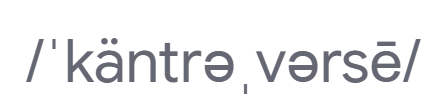
Watch the word's family too. Some endings pull the stress towards them: ANalyse becomes aNALysis, then anaLYtical. Others leave it alone: eFFECtive stays eFFECtiveness. And when you write the word down, mark the strong syllable in capitals straight away: aNALysis, or draw its beat: oOo.
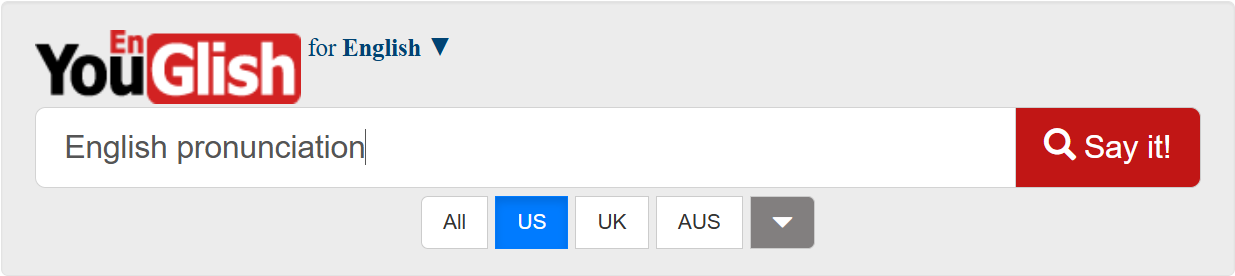
Step 3: Use YouGlish for expressions. Train your listening and your production on natural, fast-paced expressions, and strengthen your professional vocabulary at the same time: 1) select the English variant (US, UK, AUS, or other); 2) enter your keywords in the search box; 3) click on "Say it!"; 4) explore how native speakers use the words or expressions in context. Repeat them out loud until you get their pronunciation and stress right.
Step 4: Shift from volume to vocal quality. Replace the idea of loudness with vocal quality. Keep your stressed vowels full and clear, and slow down when you use long, words. Keep this in mind and do it in real conversations.
Step 5: Spaced repetition. Spaced repetition means practicing the same words (including their correct stress) over several days with growing breaks in between, rather than all at once. Lock the patterns in. .
Make Every Syllable Count
Word stress is often the real reason non-native speakers struggle to understand fast spoken English, and are hard to understand when they speak, even when their grammar and individual sounds are right. Normal classes and apps often miss this and with the rhythm of their native language. By finding your language trap, learning the stress with every new word, and using clear vowel quality instead of extra volume on stressed syllables, you can train your ear to catch what fast speech is really doing, and improve your own speech so native speakers understand you more easily.
You can't get back the years spent guessing why native speakers didn't understand you, but you can starting today. Keep your vowels clear, your curiosity sharp, and make every syllable count.